




PIXE (Particle-Induced X-ray Emission) identifies and quantifies simultaneously most of the elements present in a sample, with sensitivity of the order of ppm. Unlike RBS, NRA or ERDA, it does not give a depth profile, but the overall elemental composition of the sample in a single measurement.
Physical principle
The incident beam ejects an electron from an inner shell of the target atoms. The electronic rearrangement that follows is accompanied by the emission of an X-ray characteristic of the element concerned, which is detected and analysed in energy. The signal depends on:
- The nature of the target atom, via the energy of the characteristic X-ray lines (each element has its own signature)
- The concentration of that element, via the signal intensity, integrated over the whole beam path in the sample, with no depth information
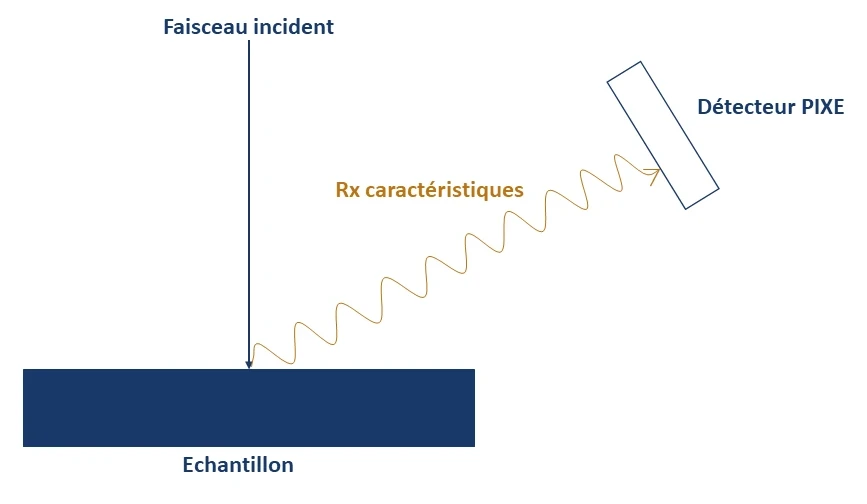
Technical characteristics
- Incident beam: ¹H⁺, 1 to 2.2 MeV
- Detector: Si(Li) detector.
- Sensitivity: of the order of ppm (parts per million) for many elements
- Detected elements: Z ≳ 11 (sodium and beyond), all simultaneously
- Analysed depth: up to a few µm.
Advantages
- Multi-elemental: all elements detected simultaneously in a single acquisition
- Very good sensitivity to trace elements (ppm)
- Non-destructive and fast
Limitations
- No depth resolution: overall composition, not a profile
- Not sensitive to very light elements (H to Ne), whose low-energy X-rays are strongly absorbed
- Continuous bremsstrahlung background that limits sensitivity for some elements
Typical applications on SAFIR
- Rapid identification of trace elements in an unknown sample
- Analysis of geological, environmental or heritage materials
- Purity control and detection of metallic contaminants
Complementarity with other techniques
PIXE complements RBS, NRA and ERDA by giving, in a single measurement, the list and amount of the elements present, including trace levels, where the other techniques target a depth profile for a given element or range of elements.
Reference publication
S.A.E. Johansson, T.B. Johansson, “Analytical application of particle induced X-ray emission”, Nuclear Instruments and Methods, vol. 137, p. 473, 1976. DOI: 10.1016/0029-554X(76)90470-5