


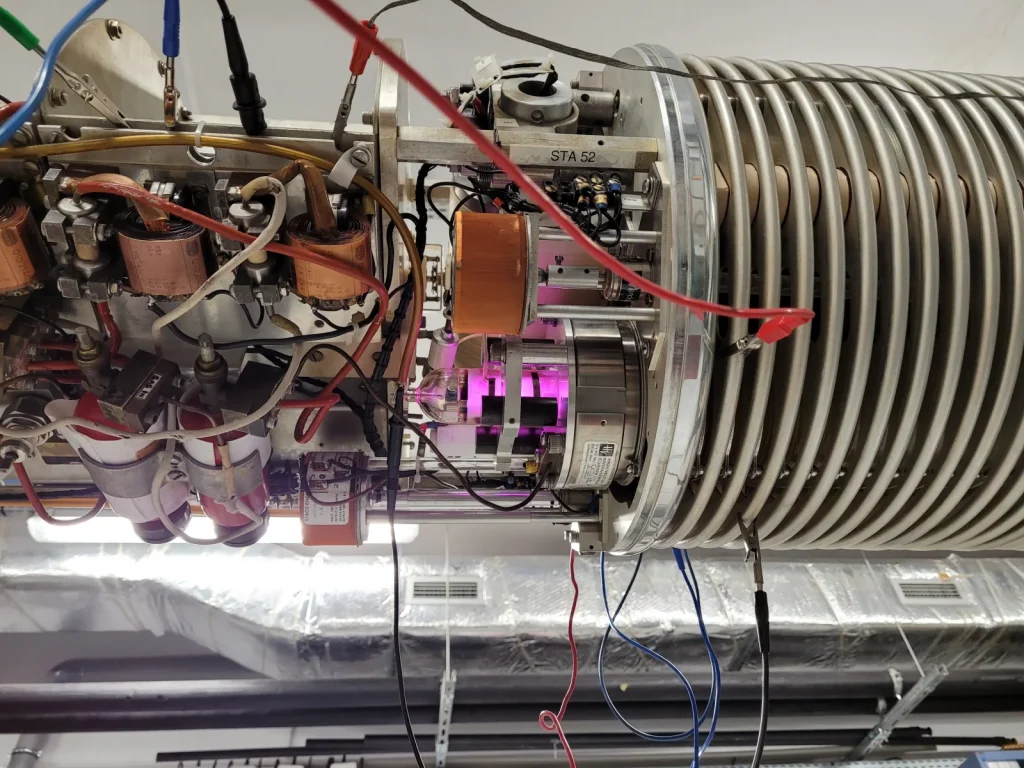
Terminal of the INSP Van de Graaff accelerator
The SAFIR Platform offers a set of complementary Ion Beam Analysis (IBA) techniques, enabling qualitative and quantitative characterisation of the near-surface region of solids.
These techniques rely on the interaction of fast charged-particle beams produced by the Van de Graaff accelerator with the atoms making up the sample to be analysed. They make it possible to determine:
- Elemental and isotopic composition
- Depth concentration profiles
- Thin-film thickness (from nm to µm)
- Crystalline order and structural defects
| Method | Incident particle | Detected elements | Depth resolution | Typical application |
|---|---|---|---|---|
| RBS | ⁴He⁺ (100 keV – 2.2 MeV) | Z > 6 (medium/heavy) | 10-20 nm | Metallic films, oxides |
| ERDA | ⁴He⁺ | H, D | 10 nm | Hydrogen, light isotopes |
| NRA | p, d, α | Li, B, C, N, O, F | ~100 nm | Nitrides, oxides, carbides |
| NRP | p, d | Specific isotopes | <1 nm | Ultra-fine isotopic profiles |
| PIXE | ¹H⁺ (1-2.2 MeV) | Z ≳ 11 (Na and beyond) | None (bulk composition) | Trace elements, multi-elemental |
| MEIS * | H⁺ (150-400 keV) | Z > 6 (medium/heavy) | <1 nm (sub-nm) | First monolayers |
* MEIS: the analysis chamber is operational for RBS and NRA; the electrostatic analyser specific to the MEIS technique is still being commissioned and is not yet available for routine measurements.
Ion implantation
In addition to analysis, the SAFIR Platform also allows ions to be implanted into a material (semiconductor doping, irradiation studies), with precise control of dose and depth. Learn more about ion implantation.