




ERDA (Elastic Recoil Detection Analysis) enables detection of light elements, hydrogen and deuterium, with sub-monolayer sensitivity. It is the reference technique on SAFIR for measuring hydrogen, which is invisible in conventional RBS.
Physical principle
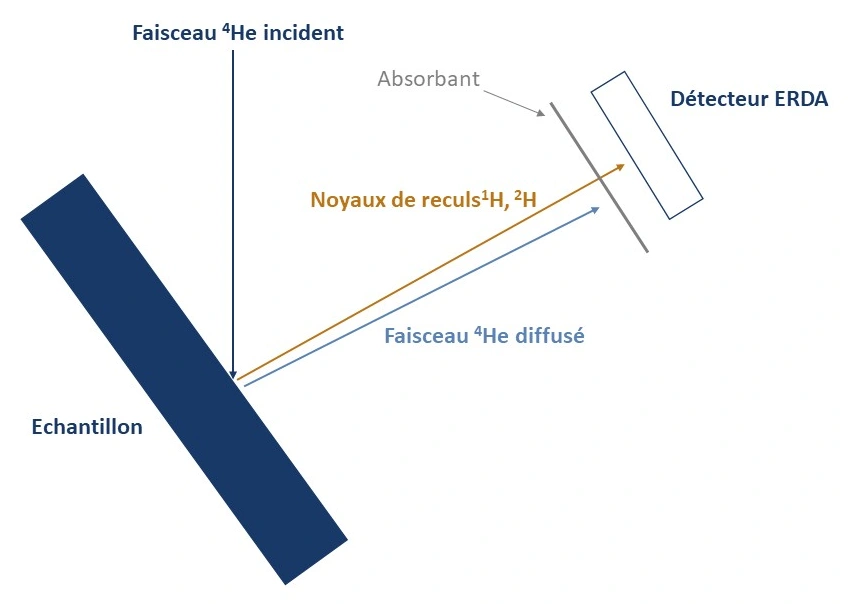
Unlike RBS, which analyses backscattered incident ions, ERDA analyses in energy the target atoms ejected (“recoiled”) during an elastic collision at small impact parameter. The analysis beam is sent onto the sample at grazing incidence, and detection is done in the forward direction. The energy of the recoil atom depends on:
- The depth at which the collision takes place (energy loss on the way in as well as on the way out)
- The mass of the recoil atom (kinematic factor, as in RBS)
Technical characteristics
- Incident beam: ⁴He⁺, typically 2 MeV for hydrogen, 1.8 MeV for deuterium
- Geometry: grazing incidence (θlab = 30°, tilt = 75° in the standard SAFIR geometry)
- Detector: silicon detector, absorber foil (mylar, ~10 µm) in front of the detector to stop scattered incident ions
- Sensitivity: a few monolayers in favourable cases
- Depth resolution: 10 nm at the surface
- Analysed depth: of the order of a micron, depending on the stopping power of the matrix
Advantages
- Sensitivity to hydrogen and deuterium
- H/D isotopic tracing possible thanks to deuterated polystyrene reference targets
- Fills the blind spot of RBS for elements lighter than the incident ion
- Direct quantitative analysis by comparison with a reference
Limitations
- Possible hydrogen desorption under the beam: requires limiting the dose per analysis spot
- Sensitive to surface contamination (atmospheric hydrocarbons), which can skew the measurement of small quantities
- Depth resolution that degrades quickly with depth, due to the energy spread associated with grazing incidence
Typical applications on SAFIR
- Measurement of hydrogen and deuterium in thin films (polymers, oxides, semiconductors)
- Study of degradation and interdiffusion of polymer films under irradiation
- Monitoring hydrogenation/dehydrogenation of functional materials
Complementarity with other techniques
ERDA is directly complementary to RBS, which does not detect elements lighter than the incident ion: the two techniques are often carried out with the same ⁴He beam on the same sample, to obtain a complete profile including hydrogen.
Reference publication
X. Wu, A. Seyeux, I. Vickridge, S. Voyshnis, P. Marcus, “ToF-SIMS and ERDA study of hydrogen and deuterium in nickel-base alloys oxidized in water”, Corrosion Science, 2018. See on HAL